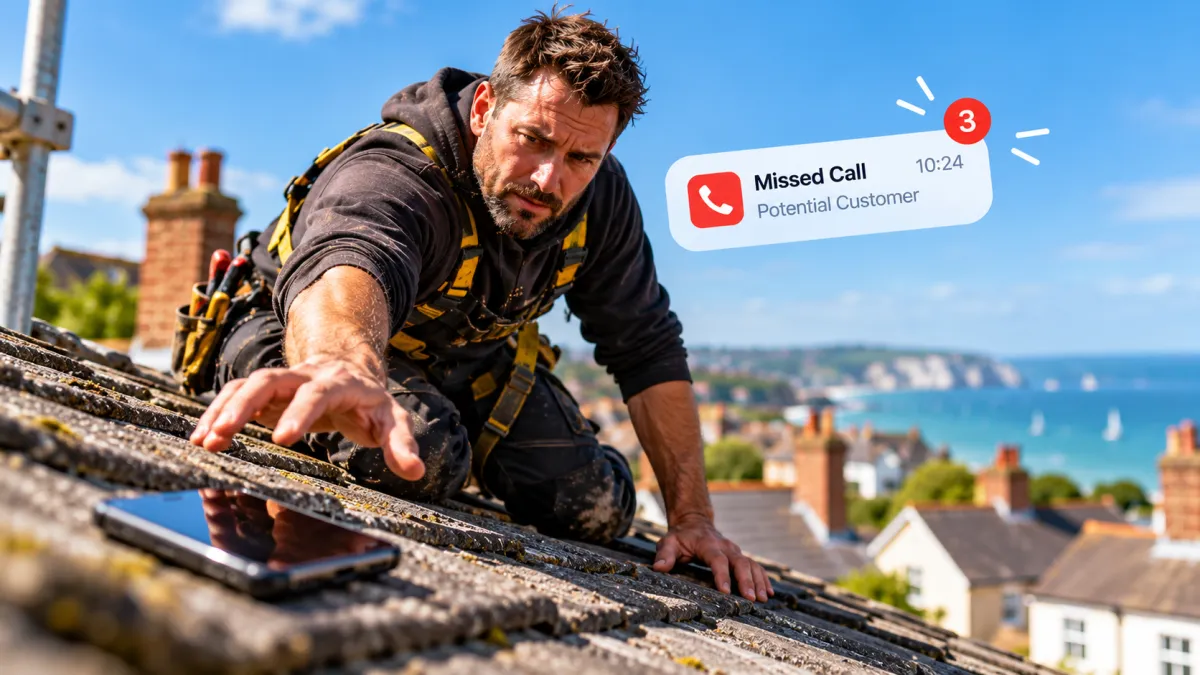
You’re on the roof. Your phone’s ringing. What happens to that £4,000 enquiry?
You’re halfway through a job.
Maybe you’re on a roof. Perhaps you’re up a scaffold, underneath a boiler, rewiring a consumer unit or laying tiles with your hands covered in adhesive.
Then your phone rings.
You could stop what you’re doing, climb down, clean yourself up and answer it.
Or, like most busy tradespeople, you think: “I’ll call them back when I’m finished.”
The problem is that your potential customer might not wait.
How missed calls can cost tradespeople new work
When somebody needs a roofer, plumber, electrician or other tradesperson, they’ll often contact several businesses.
If the first one doesn’t answer, calling the next one takes seconds.
That means the call you missed while you were doing the work you're actually being paid to do could have been your next customer.
And there’s a frustrating contradiction here.
The busier and more successful you become, the harder it can be to answer new enquiries.
You shouldn’t have to choose between looking after the customer in front of you and winning the next one.
What can a trades business do about missed calls?
There are several ways to make sure a customer gets a response when you can't answer the phone.
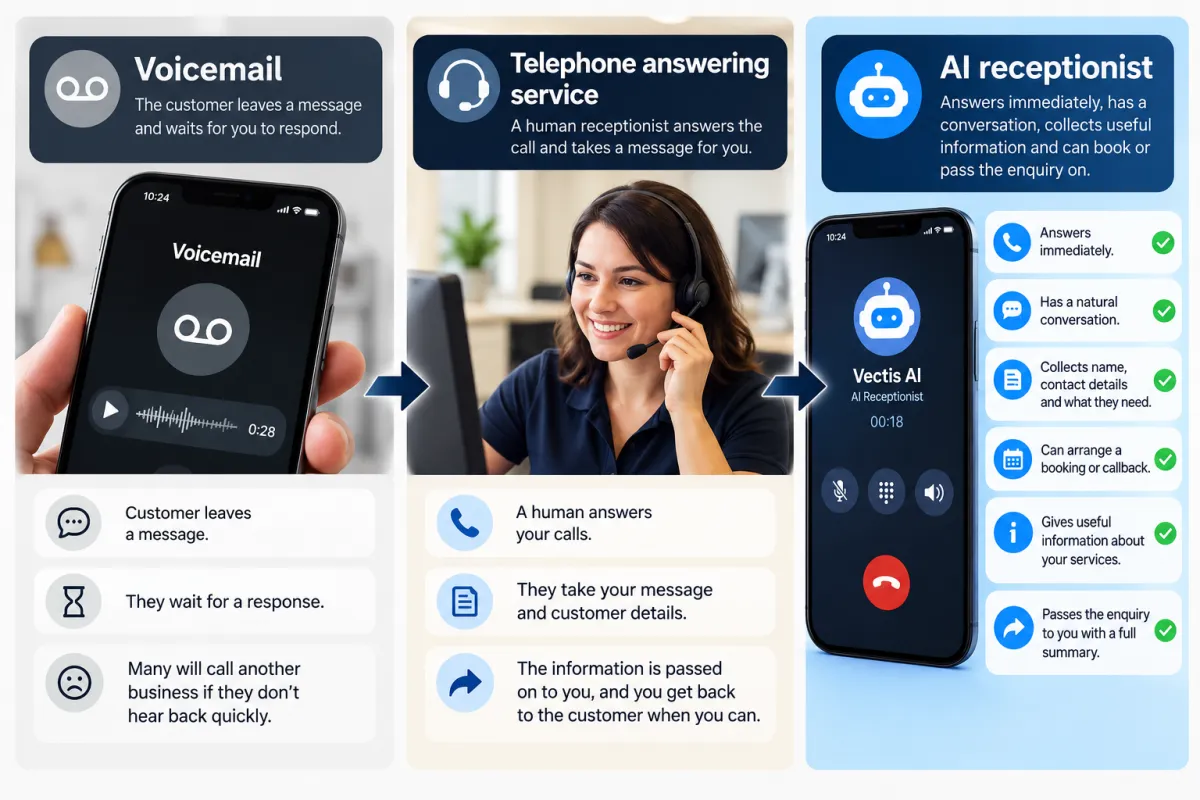
Voicemail
Voicemail has been solving this problem for decades.
It works, but it still asks the potential customer to leave a message and wait for somebody to respond.
Telephone answering services
A human receptionist or telephone answering service can answer calls when you can’t.
For this to work well, however, they need to understand enough about your business to give customers useful information.
AI receptionists
More recently, AI receptionists have created another option for small businesses and tradespeople.
Instead of simply recording a message, an AI receptionist can have a conversation with the customer, collect useful information and help determine what should happen next.
What does an AI receptionist actually do?
Forget the technology for a moment.
Think of an AI receptionist as somebody whose job is to deal with the first part of a customer enquiry while you carry on working.
Depending on how the system has been configured, an AI receptionist can:
Answer a customer immediately.
Respond to common questions about your business.
Collect their name and contact details.
Establish what they need.
Pass the enquiry to you.
Arrange an appointment or callback.
Respond when you're working, driving or finished for the day.
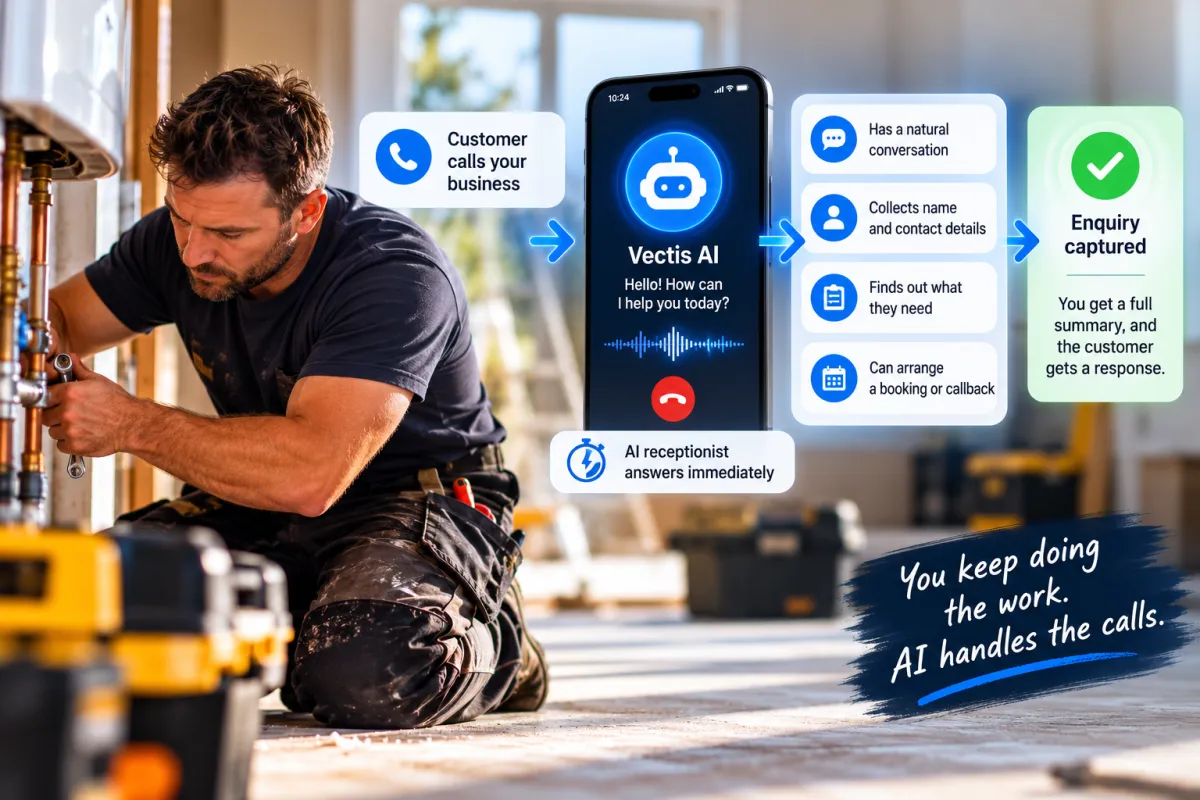
It doesn't need to replace you.
It deals with the interruption so you don't have to.
An AI receptionist needs to understand your business
This is the important bit.
An AI receptionist that knows nothing about your business isn't particularly useful.
A roofer doesn't want an AI promising a customer that somebody can inspect a roof tomorrow when the diary is full.
A garage doesn't want it booking work the workshop doesn't currently have capacity to handle.
And a plumber doesn't want it confidently answering a question that should really be referred to the plumber.
The useful part isn't simply having AI.
It's making sure the AI knows what it should say, what it shouldn't say and when it should hand something over to a human.
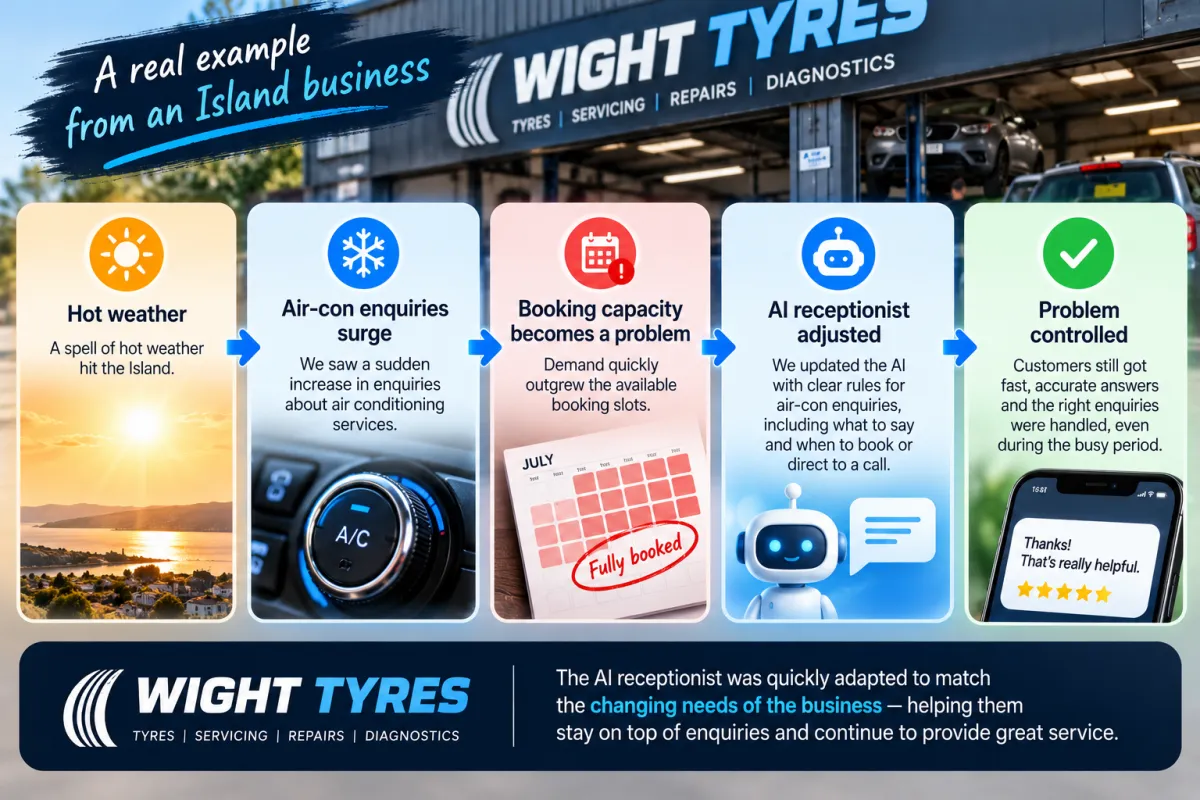
What happens when your business changes?
Your business doesn't stay exactly the same throughout the year.
You may become unusually busy.
Opening hours change.
Services change.
Staff go on holiday.
A particular type of work might temporarily be unavailable.
Seasonal demand can also change things very quickly.
An AI receptionist or booking system therefore needs to reflect the real business today, not simply the business as it looked when the system was first set up.
That is one reason ongoing monitoring and adjustment can be just as important as the initial setup.
AI can handle website enquiries too
Phone calls aren't the only enquiries that arrive while you're working.
Someone may find your website at 8:30 in the evening.
They might want to know whether you cover their area, whether you provide a particular service or how they can arrange a quote.
A well-configured AI website assistant can deal with many of those initial questions immediately.
Again, the point isn't to replace the tradesperson.
It's to make sure a potential customer gets a useful response while the tradesperson is doing something else.
Do tradespeople need to understand AI to use it?
No.
This may be one of the biggest misconceptions about using AI in a small business.
Using AI doesn't mean spending your weekends learning about artificial intelligence, writing complicated prompts or becoming an expert in new technology.
Most tradespeople don't particularly care how their accounting software works internally. They just want it to produce the right numbers.
AI should be treated in much the same way.
The question isn't:
“Should my roofing business be using artificial intelligence?”
A much better question is:
“What happens to my customers when I'm too busy to answer them?”
If the answer is “they wait until I call them back”, there are now other options worth investigating.
Could an AI receptionist help your trade business?
An AI receptionist won't be necessary for every business.
But if you regularly finish a job and discover missed calls, receive enquiries outside working hours or find yourself constantly interrupting work to answer routine customer questions, there may be a genuine business case for it.
Because the next time your phone rings while you're forty feet above the ground, the person calling might not just be another interruption.
They might be your next £4,000 job.
Want someone else to take care of the AI?
Vectis AI builds and manages AI enquiry systems for small businesses.
We learn how your business actually works, configure the AI around your services and customers, test it properly and continue to adjust it when your business changes.
You don't need to learn how to build or manage an AI receptionist.
That's our job.
Copyrights 2026 | Vectis Auto AI™ | Terms & Conditions | Cookie Policy | Privacy Policy