Your hands are covered in tile adhesive. Do you really want to answer your phone?

You're halfway through tiling a bathroom.
Your hands are covered in adhesive, you've finally got the tile sitting exactly where you want it, and your phone starts ringing.
It's probably in your pocket.
Or sitting somewhere safely out of the way because it cost you several hundred pounds and you'd rather not cover it in tile adhesive.
So you let it ring.
Perfectly reasonable.
But the person calling doesn't know any of that.
They don't know you're busy doing the job somebody else is paying you to do.
All they know is that they called a tradesperson and nobody answered.
And calling the next one takes a few seconds.
Being unavailable doesn't mean you're bad at customer service
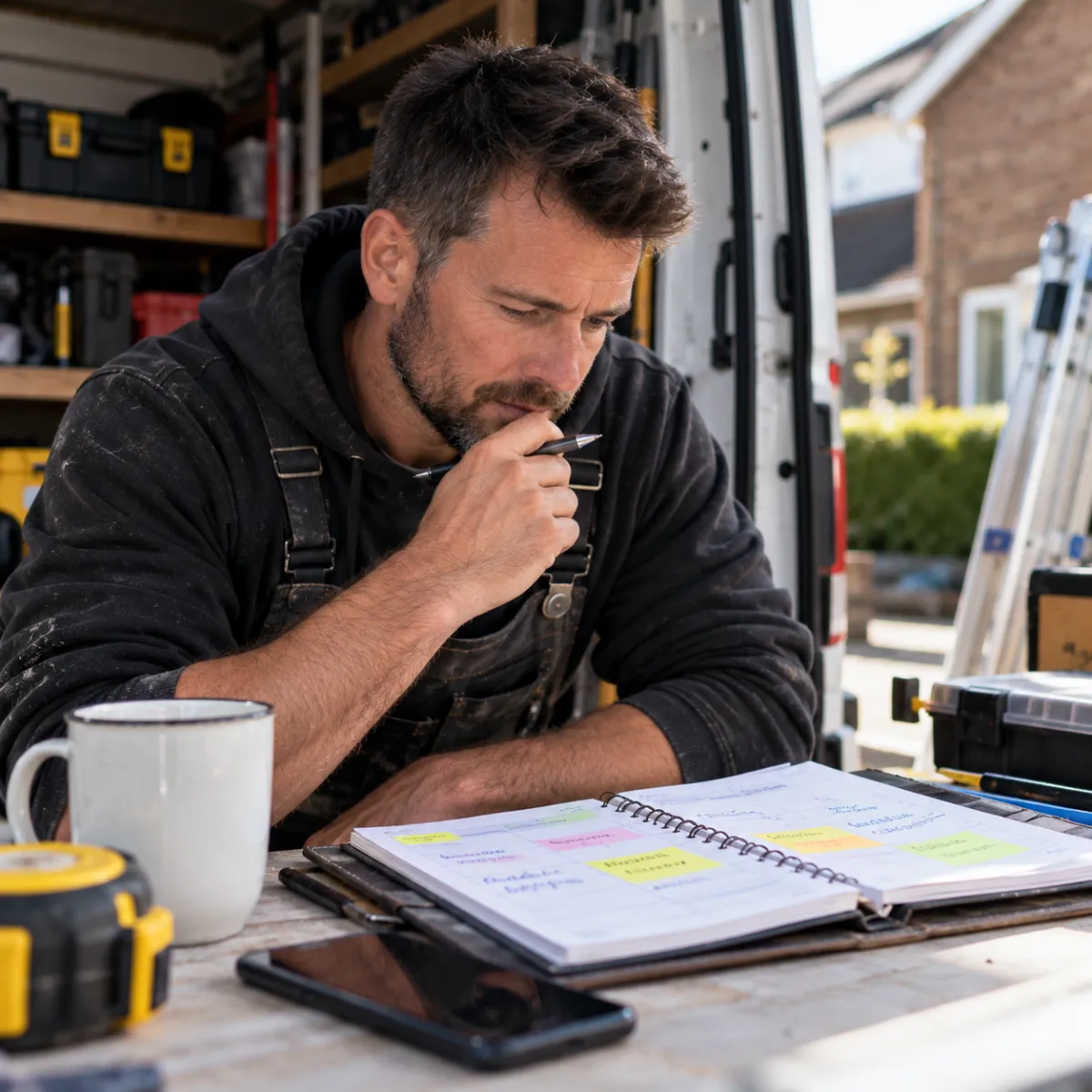
For many tradespeople, being difficult to reach is actually a consequence of doing the job properly.
A plumber might be underneath a sink.
An electrician might be working at a consumer unit.
A roofer might be several metres above the ground.
A scaffolder might be halfway through erecting a scaffold.
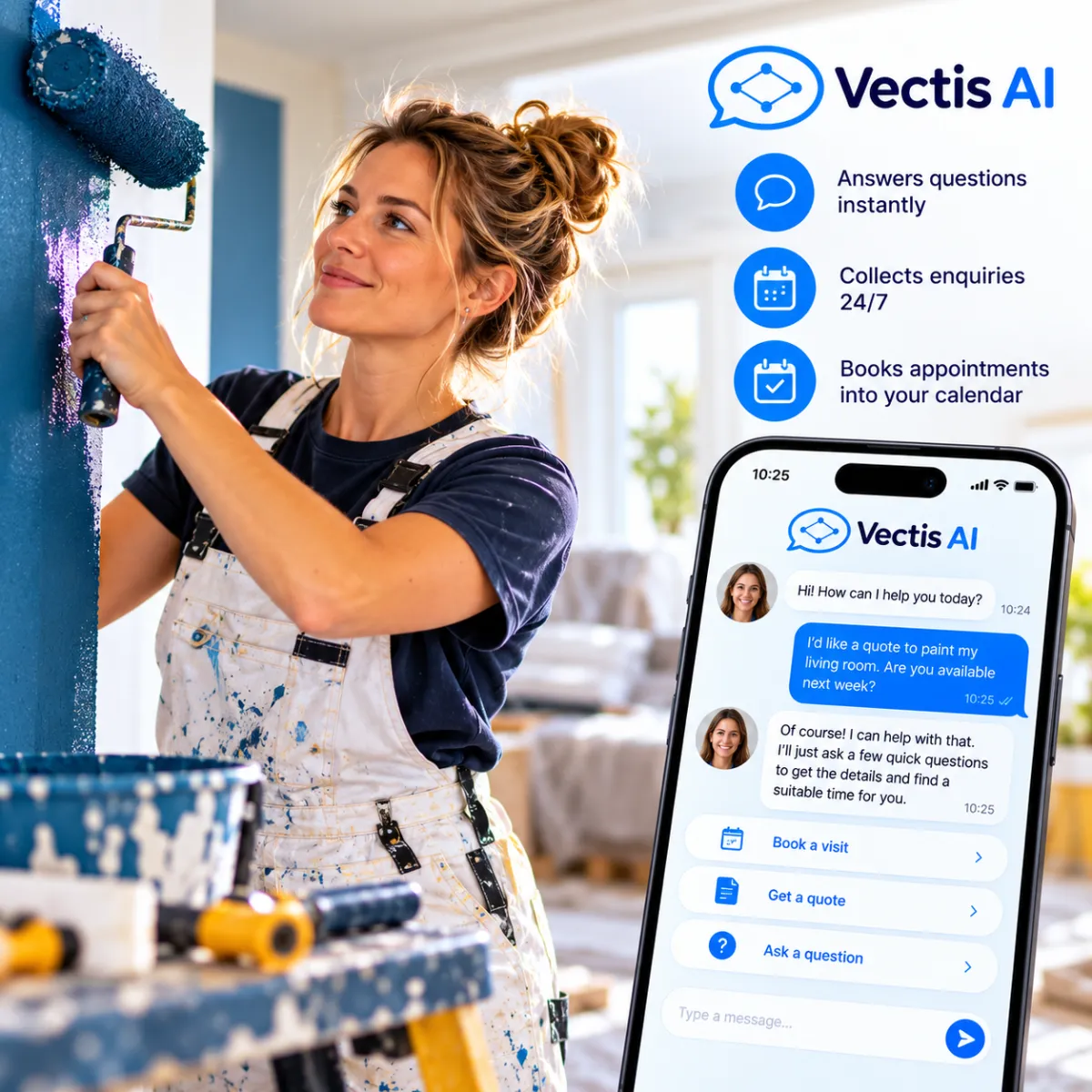
A decorator might have a roller in one hand and a paint tray in the other.
A mechanic might be underneath a car.
None of them should necessarily stop what they're doing every time the phone rings.
The problem is that a potential customer can't see what's happening at the other end of the phone.
To them, there's just no answer.
What happens to the enquiry when you can't answer?
Traditionally, a small trades business has had a handful of choices.
You can let the call go to voicemail.
You can divert calls to somebody else.
You can employ a receptionist.
Or you can use a telephone answering service.
All of those can work.
But there is now another option available to even very small businesses: an AI receptionist.
What can an AI receptionist do while you're working?
An AI receptionist can answer the call while you carry on with the job.
Depending on how it's been configured, it can:
Answer the customer immediately.
Ask what they're calling about.
Collect their name and contact details.
Find out where the job is located.
Answer common questions about your services.
Establish whether the enquiry is something your business handles.
Arrange an appointment or callback where appropriate.
Pass the details of the enquiry to you.
So instead of finishing the job and discovering three missed calls, you can finish the job and discover three properly captured enquiries.
That's a very different situation.
The AI shouldn't pretend to be the tradesperson
This is important.
An AI receptionist isn't there to pretend it can diagnose a leaking boiler, quote for a new roof or decide how somebody's electrical fault should be repaired.
There should be clear boundaries around what it can and can't do.
Its job is to deal with the initial enquiry intelligently.
That might mean answering straightforward questions, gathering useful information, arranging a callback or passing something to a human when the customer needs expertise the AI shouldn't provide.
A good system should know when to help and when to get out of the way.
It needs to understand your business
Simply connecting an AI to your telephone number isn't enough.
A plumber who doesn't install boilers shouldn't have an AI receptionist telling customers that they do.
A roofer who only works within a particular area doesn't want enquiries booked thirty miles away.
An electrician who doesn't provide emergency call-outs shouldn't have customers expecting somebody to arrive at midnight.
The system needs to understand how the actual business works.
That means its services, opening hours, service area, booking rules and the things it should never promise.
The better it understands the business, the more useful it becomes.
What if your business changes?
It will.
Trades businesses aren't static.
You might become fully booked for the next two weeks.
A member of staff might go on holiday.
You might temporarily stop offering a particular service.
Your opening hours might change.
You might add a new service.
Or demand for one type of work might suddenly increase.
An AI receptionist needs to change with the business.
That's why setting one up properly is only part of the job.
Keeping it accurate matters too.
Do I need to understand AI to use an AI receptionist?
No.
You don't need to understand how your card payment system works internally before accepting a payment.
You don't need to understand how Google Maps calculates a route before using it to reach a customer.
And you shouldn't need to become an AI expert just to stop losing enquiries.
You know your trade.
The technology should be configured around the way you already work — not the other way around.
Is an AI receptionist right for every trades business?
Not necessarily.
If customers can already reach you easily, your website consistently turns visitors into enquiries and very few potential customers slip away, there may be little problem to solve.
But missed opportunities aren't always as obvious as a missed call.
You might finish a job and discover three unanswered calls on your phone.
At least you know those people tried to contact you.
The potential customer who visited your website can be completely different.
They may have wanted to know whether you cover their area, whether you provide a particular service or how soon somebody could look at their job.
If they couldn't get an answer easily, they may simply have gone back to Google and visited the next business.
You might never know they were there.
That's why the important question isn't simply:
“Am I missing phone calls?”
And it isn't:
“Should my business be using AI?”
A better question is:
“How many potential customers are reaching my business but leaving before they become an enquiry?”
Some opportunities arrive by telephone.
Others arrive through your website.
The useful role for AI is to help make sure more of those potential customers actually get a response — whether you're working, driving, finished for the day or simply unavailable at that moment.
Your website should be capturing enquiries too
Phone calls aren't the only opportunities a trades business can lose.
Every person who visits your website is a potential customer.
Some will be ready to call immediately.
Others may still have questions.
Do you cover my area?
Do you provide the service I need?
Can somebody look at my job this week?
Can I arrange a callback?
If visitors can't quickly find what they need, some will simply leave and try another business.
The difference is that you may never know they were there.
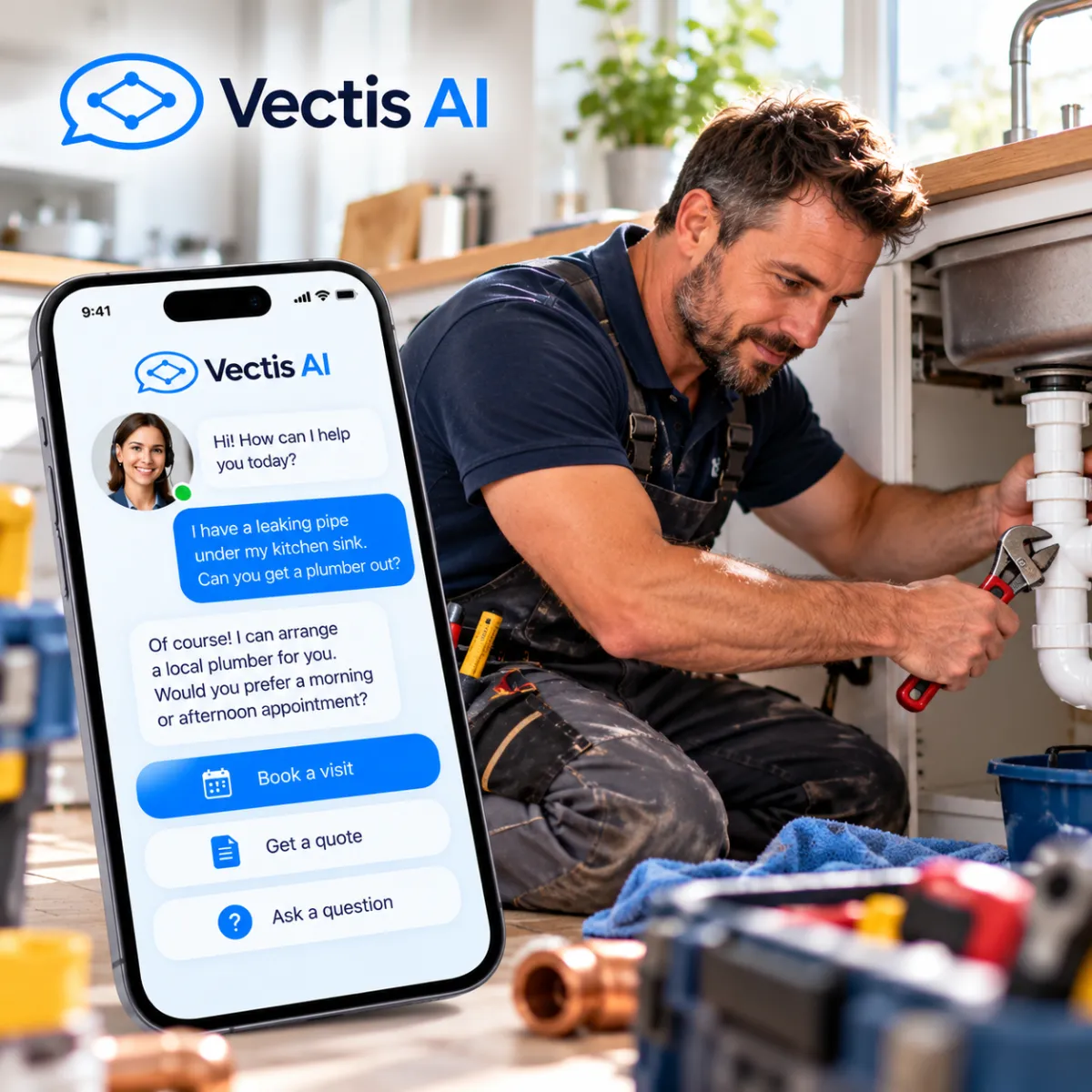
A well-configured AI website assistant gives those visitors another opportunity to engage with the business.
It can answer appropriate questions, find out what they need, collect their contact details and turn an anonymous website visitor into an identifiable enquiry.
Not every visitor will become a paying customer.
But every relevant visitor should be given a clear opportunity to become a lead.
That's the real objective: not simply getting more people onto your website, but converting more of the people who are already there.
And if you don't have a website yet, that's not a problem either.
Vectis AI can help with that too — from building the website itself to making sure it's designed to turn visitors into enquiries.
Want someone else to take care of the AI?
Vectis AI learns how your business works, configures the system around your services and customers, tests it properly and continues to adjust it as your business changes.
You don't need to learn how to build or manage AI systems yourself.
You carry on doing your job.
We'll deal with the AI.
Copyrights 2026 | Vectis Auto AI™ | Terms & Conditions | Cookie Policy | Privacy Policy