AI for tradespeople: what can it actually do for a small business?
If you run a plumbing, roofing, electrical, building or other trade business, there's a reasonable chance you've heard quite enough about artificial intelligence already.
AI writes things.
AI makes pictures.
AI is apparently going to change everything.
But there's a much more useful question:
Can it actually do anything useful for your business today?
The answer is yes — but probably not in the way some of the hype suggests.
Here are some of the practical jobs AI can already help small trade businesses with.
1. Answering the phone when you can't
This is perhaps the most obvious use.
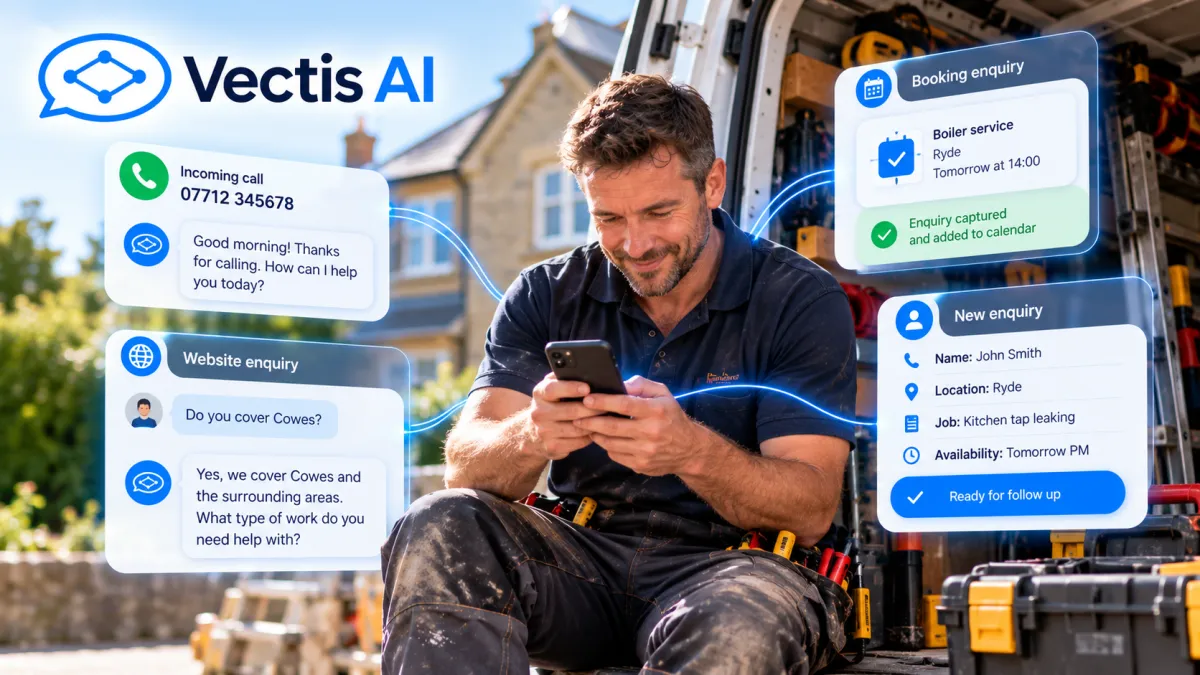
If you're driving, working at height, underneath a sink or simply dealing with another customer, an AI receptionist can answer an incoming call.
It can find out who is calling, what they need and how they can be contacted.
That means you don't necessarily have to stop working every time the phone rings.
2. Dealing with website enquiries
Not everybody wants to telephone.
Someone might discover your website during their lunch break or at ten o'clock at night.
Instead of completing a generic contact form and waiting, they can potentially have a conversation immediately.
A website AI assistant can answer common questions, explain services, establish whether the customer is in your service area and collect the information you need to follow up.
3. Answering the same questions over and over again
“Do you cover Cowes?”
“Do you work Saturdays?”
“Do you provide free quotations?”
“Can you do emergency call-outs?”
“Do you take card payments?”
You may have answered the same questions hundreds of times.
If the answers are straightforward, there's no reason you personally need to answer every one of them.
A properly constructed knowledge base allows an AI assistant to answer routine questions using information about your actual business.
4. Collecting better enquiries
A missed call tells you almost nothing.
A properly handled enquiry can tell you considerably more.
Instead of:
Missed call — 07xxx xxx xxx
you could receive:
Kitchen tap leaking.
Customer in Ryde.
Available tomorrow afternoon.
Name and contact details captured.
You still decide what happens next.
The AI simply does some of the legwork.

5. Helping with bookings
For businesses where appointments make sense, an AI system can potentially connect to a booking calendar.
That doesn't mean giving customers unlimited access to your diary.
Rules can determine what can be booked, when appointments are available and which enquiries should instead be passed to a person.
This is one of the areas where proper setup matters.
The system needs to match how the business actually operates.
6. Responding outside normal working hours
Your business may close at 5pm.
The internet doesn't.
Potential customers search in the evenings, early in the morning and at weekends.
An AI assistant can still respond to an initial enquiry even though nobody from the business is currently working.
That doesn't mean pretending somebody is available when they aren't.
It means acknowledging the customer and gathering the information needed for the next step.
What shouldn't AI do?
This matters just as much.
AI shouldn't be allowed to confidently invent information.
It shouldn't promise services you don't offer.
It shouldn't make bookings you can't fulfil.
And it shouldn't give technical advice in situations where a qualified human needs to make the judgement.
A useful AI system therefore needs boundaries.
It needs to understand:
What do we know?
What are we allowed to do?
When do we hand this to a person?
Do I have to set all this up myself?
No.
There are increasingly AI receptionist products that businesses can buy and configure themselves.
For some people, that's perfect.
But plenty of tradespeople have absolutely no desire to spend their evenings learning another piece of software.
A managed service takes a different approach.
Someone learns how your business operates, builds the knowledge base, establishes the rules, tests the conversations and adjusts the system when circumstances change.
You don't become the AI expert.
You remain the plumber, roofer, electrician, mechanic or builder.

Is AI right for every tradesperson?
Not necessarily.
If virtually all your work comes from long-standing customers and you rarely receive new enquiries, an AI receptionist may solve a problem you don't actually have.
But if you regularly find missed calls on your phone, receive enquiries while you're working or spend evenings responding to messages that arrived during the day, it's worth investigating.
Don't start with:
“How can I use AI?”
Start with:
“Which repetitive parts of dealing with customers take up my time or cause me to lose enquiries?”
If technology can deal with some of those without making the customer experience worse, that's where AI becomes useful.
Not futuristic.
Not revolutionary.
Just useful.
Want to see what this could look like for your business?
Vectis AI builds and manages AI reception and enquiry systems for small businesses, including website AI, voice, bookings and telephone answering.
We're based on the Isle of Wight and configure the technology around the individual business rather than expecting the business owner to become an AI expert.
You know your trade.
We know the AI.
Copyrights 2026 | Vectis Auto AI™ | Terms & Conditions | Cookie Policy | Privacy Policy